🔄 OBSTETRICS · OB WHEEL
OB Wheel Pregnancy Calculator & Gestational Age
Free online OB wheel — calculate EDD, gestational age, and pregnancy milestones instantly from LMP, ultrasound, or IVF transfer date. FOGSI · ACOG · WHO guidelines.
Online OB Wheel Calculator & Obstetric Suite
Clinical-grade calculator for GA by LMP, Scan Dating, and Week-by-Week Progress.
Calculate Gestational Age via Last Menstrual Period
Digital equivalent of a physical plastic obstetric wheel. Enter your LMP and cycle length below for immediate due date and clinical milestone calculations.
Calculate Gestational Age via Ultrasound Scan
Back-calculate EDD and LMP from ultrasound dating. First-trimester CRL (7–12 weeks) is more accurate than LMP for irregular cycles.
Calculate Gestational Age via IVF Transfer Date
Calculate precise due date and gestational age for pregnancies achieved through assisted reproductive technology (ART).
Calculate Gestational Age on a Specific Date
Find exact gestational age on a specific date — for OT notes, discharge summaries, referral letters, or medico-legal documentation.
Reverse-Calculate LMP from EDD
Reverse pregnancy wheel — calculate LMP and conception date when only the EDD is known. Useful when reviewing records or referral notes.
All four modes above use the same clinical formula — Naegele's Rule adjusted for cycle length — so results stay consistent whether you're dating from LMP, an ultrasound scan, or working backward from a known due date.
When to Revise Due Date by Ultrasound (ACOG Committee Opinion No. 700)
Ultrasound measurement in the first trimester is the most accurate method to confirm gestational age. When menstrual dating (LMP) and ultrasound measurements disagree beyond the following thresholds, the EDD should be revised:
| Gestational Age Range | Primary Method | Discrepancy Threshold | Action |
|---|---|---|---|
| ≤ 8 6/7 weeks | Crown-Rump Length (CRL) | > 5 days | Redate by ultrasound |
| 9 0/7 – 13 6/7 weeks | Crown-Rump Length (CRL) | > 7 days | Redate by ultrasound |
| 14 0/7 – 15 6/7 weeks | BPD, HC, AC, FL | > 7 days | Redate by ultrasound |
| 16 0/7 – 21 6/7 weeks | BPD, HC, AC, FL | > 10 days | Redate by ultrasound |
| 22 0/7 – 27 6/7 weeks | BPD, HC, AC, FL | > 14 days | Redate by ultrasound |
| ≥ 28 0/7 weeks | BPD, HC, AC, FL | > 21 days | Redate by ultrasound |
Pregnancy Wheel — Week-by-Week Milestones
The OB wheel tracks gestation through 40 weeks across three trimesters. Use this table alongside the pregnancy wheel calculator above to understand each week's clinical significance.
| Week | Trimester | Key Milestone / Clinical Event | Approx. EFW |
|---|---|---|---|
| 4–6w | 1st | Implantation, hCG rise, gestational sac visible on USS | — |
| 7–8w | 1st | Fetal heart activity visible; best window for dating scan (CRL) | ~1–2 g |
| 11–13w | 1st | NT scan; combined first-trimester screening (PAPP-A, free β-hCG) | ~20–40 g |
| 13w | 1st | End of 1st trimester; miscarriage risk drops sharply | ~65 g |
| 16–18w | 2nd | Quickening felt; quad screen window (AFP, hCG, uE3, inhibin-A) | ~150–200 g |
| 18–20w | 2nd | Anomaly scan (Level 2 USS); detailed fetal anatomy survey | ~200–300 g |
| 24–28w | 2nd | Universal GDM screening (DIPSI 75g GTT); Anti-D for Rh-negative | ~600–1000 g |
| 32–34w | 3rd | Growth scan; high-risk GDM rescreen; GBS swab consideration | ~1700–2150 g |
| 36–37w | 3rd | Late-preterm; assess presentation, Bishop score, induction planning | ~2600–2900 g |
| 38–40w | 3rd | Term; EDD at 40 weeks; induction discussion if post-dates | ~3100–3500 g |
| 41–42w | 3rd | Post-dates; CTG monitoring; induction recommended by 42 weeks | ~3400–3700 g |
Fetal Biometry by Gestational Week — CRL, BPD, HC, AC & FL
Just like the parameter dials on a physical obstetric wheel, this reference table lists the expected mean ultrasound biometry values at each stage of gestation, based on the Hadlock (1984) growth nomograms used worldwide, including in Indian FOGSI/ICMR obstetric practice.
| GA (weeks) | CRL (mm) | BPD (mm) | HC (mm) | AC (mm) | FL (mm) | Approx. EFW |
|---|---|---|---|---|---|---|
| 7w | 10 | — | — | — | — | ~1 g |
| 8w | 16 | — | — | — | — | ~2 g |
| 9w | 23 | — | — | — | — | ~4 g |
| 10w | 31 | — | — | — | — | ~7 g |
| 11w | 41 | — | — | — | — | ~14 g |
| 12w | 53 | 21 | 74 | 60 | 8 | ~23 g |
| 13w | 66 | 24 | 87 | 68 | 11 | ~43 g |
| 14w | — | 27 | 98 | 78 | 13 | ~70 g |
| 16w | — | 32 | 124 | 99 | 21 | ~135 g |
| 18w | — | 40 | 151 | 125 | 27 | ~215 g |
| 20w | — | 46 | 177 | 149 | 33 | ~320 g |
| 22w | — | 53 | 201 | 173 | 38 | ~460 g |
| 24w | — | 59 | 224 | 196 | 44 | ~630 g |
| 26w | — | 65 | 246 | 218 | 49 | ~870 g |
| 28w | — | 71 | 266 | 240 | 54 | ~1100 g |
| 30w | — | 76 | 284 | 260 | 58 | ~1400 g |
| 32w | — | 81 | 301 | 280 | 63 | ~1700 g |
| 34w | — | 85 | 316 | 299 | 67 | ~2150 g |
| 36w | — | 89 | 328 | 317 | 71 | ~2600 g |
| 38w | — | 92 | 338 | 335 | 74 | ~3100 g |
| 40w | — | 95 | 346 | 351 | 77 | ~3400 g |
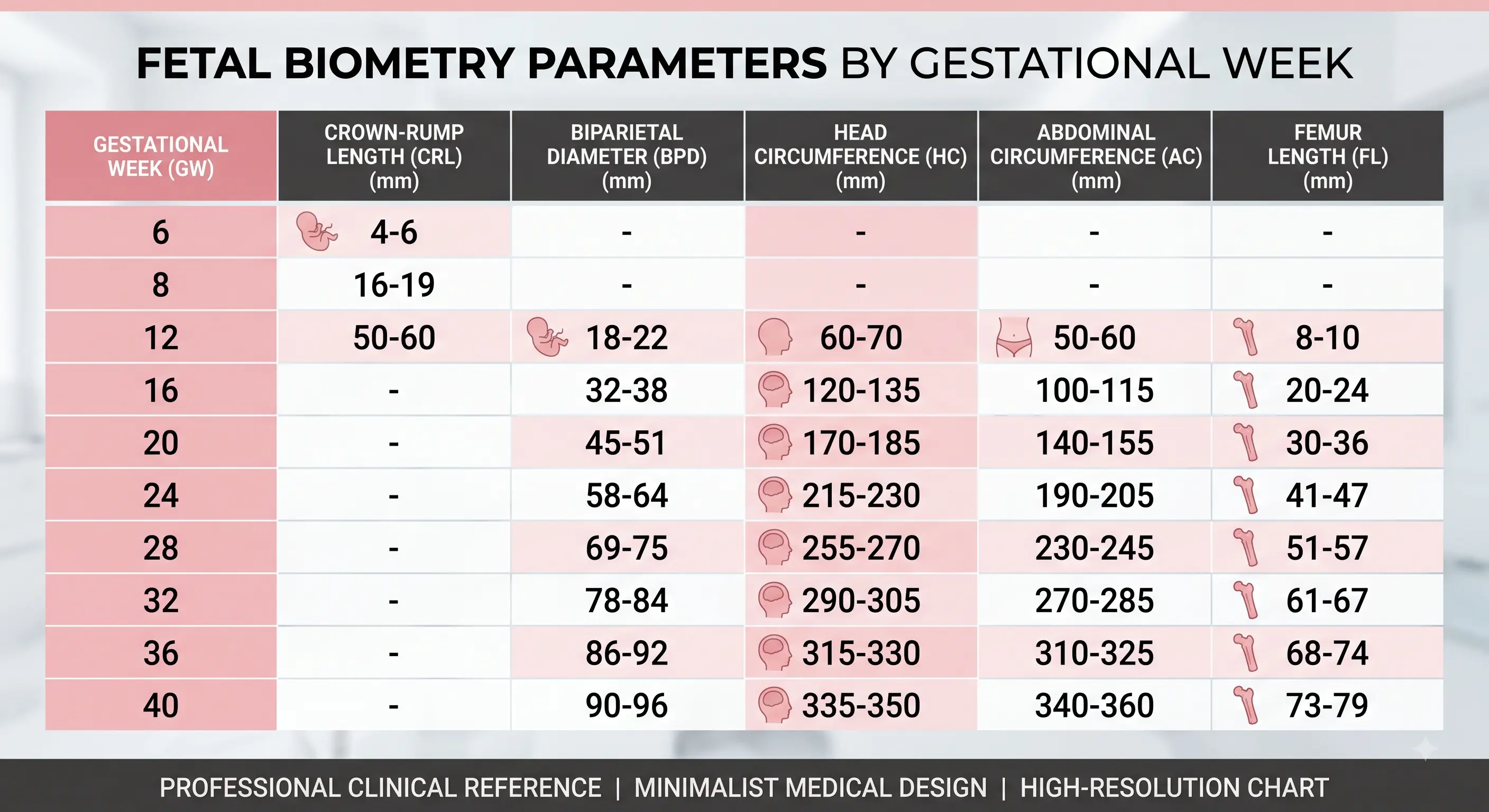
Need an exact estimated fetal weight from a real scan report? Use the Hadlock EFW Calculator to plug in your own BPD/HC/AC/FL and get a precise weight and percentile.
Prenatal Tests, Screening Schedule & Trimester-wise Precautions
The reverse side of a printed pregnancy wheel usually lists the standard antenatal lab panel, bleeding differentials, and a quantitative β-hCG dating guide. The same reference is reproduced below, trimester by trimester, for quick lookup alongside the GA/EDD calculator above.
Baseline Antenatal Lab Panel (first ANC visit)
CBC, blood group & type with Rh factor, antibody (indirect Coombs) screen, urine routine/microscopy, rubella IgG titer, HIV, VDRL/RPR or PPD as indicated, hepatitis B/C profile, cultures where indicated (GC, Chlamydia), Pap smear, dating sonogram (ideally 11–14 weeks), maternal serum alpha-fetoprotein/double or quad marker for neural tube and aneuploidy screening (14–18 weeks), and a 75g OGTT (24–28 weeks, DIPSI single-step protocol in India).
Trimester-wise Tests & Precautions
| Trimester | Key Tests / Screening | Precautions & Advice |
|---|---|---|
| 1st | Booking bloods, dating scan, NT scan & combined screen (11–13w6d), folic acid started/continued | Start folic acid 400 mcg–5 mg/day, avoid alcohol/smoking/self-medication, treat nausea early, avoid known teratogens, screen for domestic violence & mental health |
| 2nd | Anomaly (Level 2) scan 18–20w, quad/triple marker if not screened earlier, OGTT 24–28w, Anti-D for Rh-negative mothers, Tdap around 27–36w | Iron & calcium supplementation, monitor weight gain and BP, report reduced fetal movements after quickening, dental & vision check, moderate exercise encouraged |
| 3rd | Growth scan 32–34w if indicated, GBS swab 35–37w, Bishop score assessment near term, daily fetal kick counts, CTG/NST if post-dates or high-risk | Left lateral sleeping position, watch for pre-eclampsia symptoms (headache, visual changes, epigastric pain, swelling), pack hospital bag by 36w, birth-plan discussion, induction counselling if >41 weeks |
When to Seek Immediate Care — Warning Signs
Differential Diagnosis of Bleeding in Pregnancy
First trimester: mistaken menstrual period, threatened/incomplete/missed/complete abortion, ectopic pregnancy (typically 5–12 weeks), cervical pathology (infection, inflammation, neoplasm), vaginal pathology (vaginitis, neoplasm), hydatidiform mole, and leiomyoma.
Third trimester: placenta previa, placental abruption, and cervical causes (inflammation, infection, erosion, contact bleeding, neoplasm, polyps) — also consider labour onset, vaginitis, coagulopathy, trauma, and incompetent cervix.
Quantitative β-hCG Dating Guide
| Gestational Stage | β-hCG Range (mIU/mL) |
|---|---|
| 0–2 weeks | 0–250 |
| 2–4 weeks | 100–5,000 |
| 1–2 months | 4,000–200,000 |
| 2–3 months | 8,000–100,000 |
| 2nd trimester | 4,000–75,000 |
| 3rd trimester | 1,000–50,000 |
β-hCG is usually first detectable roughly 11.5 days post-ovulation. Through the first 6 weeks of a normally progressing pregnancy, levels typically rise by 65–70% every 48 hours; a rise slower than this can suggest a non-viable or ectopic pregnancy and warrants clinical correlation.
What is an OB Wheel (Obstetric Wheel)?
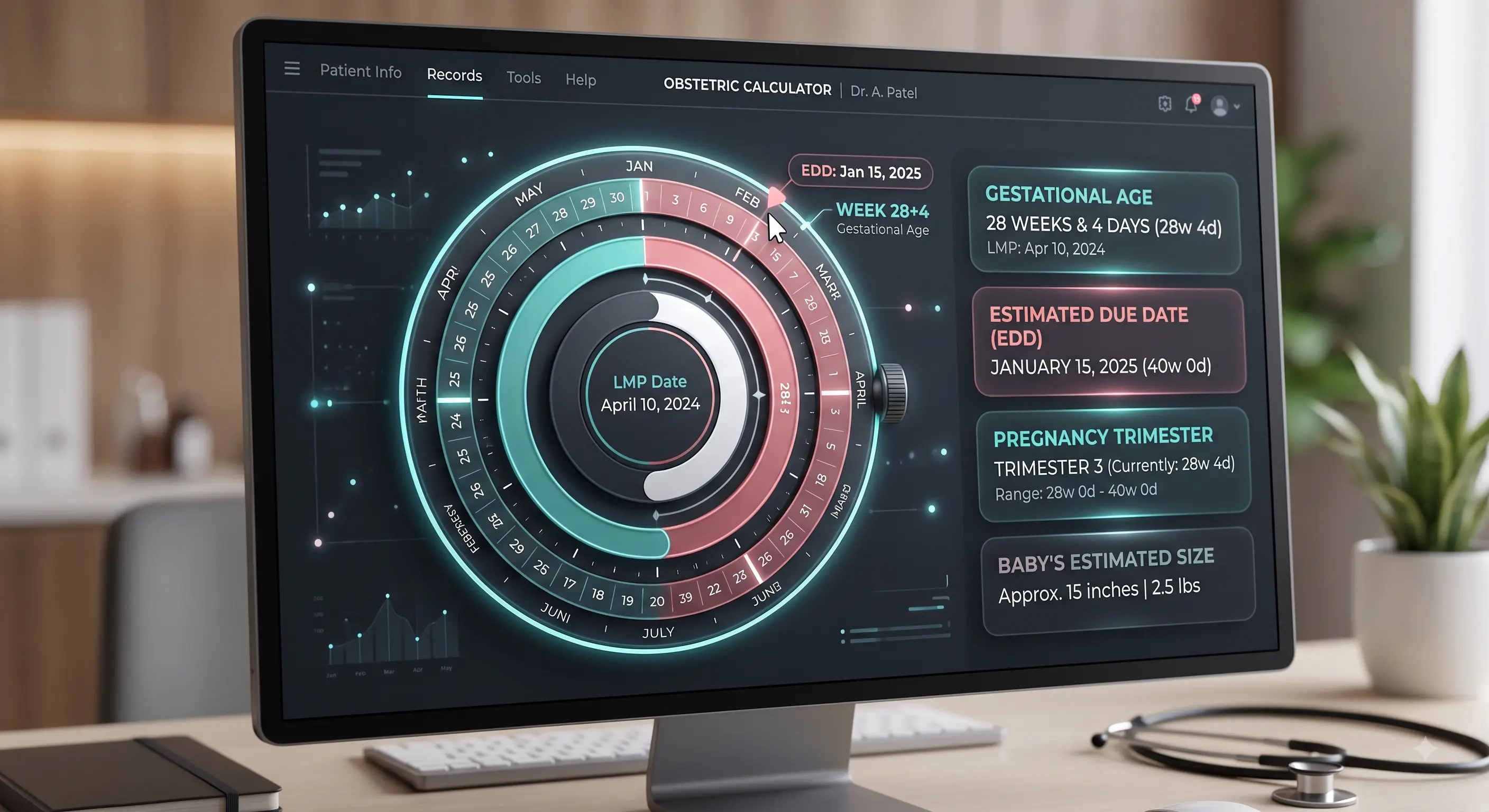
An OB wheel (also called a pregnancy wheel, obstetric wheel, or obs wheel) is a circular slide-rule tool used by obstetricians, midwives, and general practitioners to calculate gestational age and estimated due date (EDD) from the last menstrual period (LMP). It applies Naegele's Rule: EDD = LMP + 280 days, with adjustment for non-standard cycle lengths. This digital OB wheel replicates the physical wheel and extends it with the reference data printed on the back of a physical wheel — expected fetal biometry (CRL, BPD, HC, AC, FL) and approximate weight for the calculated gestational age, plus the full antenatal test schedule, trimester-wise precautions, and a quantitative β-hCG dating chart.
How to Use the Online Pregnancy Wheel
Enter the first day of your last menstrual period (LMP) in the "GA by LMP" tab and select your cycle length. The pregnancy wheel immediately calculates your estimated due date (EDD), current gestational age in weeks and days, which trimester you are in, and your approximate conception date. For non-standard cycles, the wheel adjusts Naegele's Rule by the number of days the cycle differs from 28 days.
If an ultrasound scan has already been performed, use the "GA by Scan" tab to back-calculate EDD from the ultrasound dating. For operation theatre notes or referral letters, use "GA on Date" to find exact gestational age on any calendar date. The "EDD→LMP" reverse wheel is useful when reviewing referral notes where only the due date is recorded.
OB Wheel vs Basic Due Date Calculator
| Feature | Physical OB Wheel | Basic Online | ObsCalc OB Wheel |
|---|---|---|---|
| Due date from LMP | ✓ | ✓ | ✓ + cycle adj. |
| GA from ultrasound | ✓ | ✗ | ✓ |
| GA on any specific date | ✓ | ✗ | ✓ |
| Reverse EDD → LMP | ✓ | Rarely | ✓ |
| Expected CRL/BPD/HC/AC/FL by GA | Printed chart | ✗ | ✓ Auto-shown in result |
| Prenatal test schedule & precautions | Printed on back | ✗ | ✓ |
| Quantitative β-hCG dating chart | Some models | ✗ | ✓ |
| Exact EFW / Bishop / VBAC / PPH / GDM calculators | ✗ | ✗ | ✓ Separate free tools on RxMedCalc |
| Works offline / no login | ✓ | Mostly | ✓ |
Gestational Age Calculation — How the Pregnancy Wheel Works
Gestational age (GA) is measured in weeks and days from the first day of the last menstrual period. For a standard 28-day cycle, the total pregnancy duration is 280 days (40 weeks). For non-standard cycles, Naegele's Rule is adjusted: EDD = LMP + (280 + (cycle length − 28)) days. For example, for a 32-day cycle, EDD = LMP + 284 days. This cycle-length adjustment is built into the ObsCalc OB wheel — simply select your cycle length from the dropdown.
Obstetric Wheel Terminology — Glossary
OB wheel / obs wheel / obstetric wheel: All refer to the same tool — a gestational dating wheel used in clinical obstetric practice. EDD (Estimated Due Date): Also called EDC (Expected Date of Confinement) — the date delivery is expected, calculated as LMP + 280 days. LMP: Last Menstrual Period — the first day of the last normal period before conception. GA: Gestational Age — weeks and days since LMP. CRL: Crown-Rump Length — the most accurate dating parameter in the first trimester. EFW: Expected Fetal Weight by ultrasound biometry. DIPSI: Diabetes in Pregnancy Study Group India — the GDM screening protocol used in India.
Clinical References & Practice Guidelines
- American College of Obstetricians and Gynecologists (ACOG). Committee Opinion No. 700: Methods for Estimating the Due Date. Obstet Gynecol. 2017;129(5):e150–e154.
- Hadlock FP, Harrist RB, Deter RL, Park SK. Estimating fetal age: computer-assisted analysis of multiple fetal growth parameters. Radiology. 1984;152(2):497–501.
- Federation of Obstetric and Gynaecological Societies of India (FOGSI). Clinical Practice Guidelines on Antenatal Care & GDM Screening in India. 2021.
- World Health Organization (WHO). WHO recommendations on antenatal care for a positive pregnancy experience. Geneva: World Health Organization; 2016.
Frequently Asked Questions
What is an OB wheel pregnancy calculator?
An OB wheel is a circular slide-rule used by doctors to calculate gestational age and estimated due date from the last menstrual period. This digital OB wheel does the same calculation online — enter LMP, get EDD and GA instantly — and adds several more obstetric tools used in clinical practice.
How do I use the pregnancy wheel online calculator?
Enter the first day of your last menstrual period (LMP) in the GA by LMP tab, select your cycle length (default 28 days), and press Calculate. You immediately get EDD, current gestational age in weeks and days, trimester, conception date, and a Google Calendar link for your due date.
How many weeks pregnant am I?
Enter your LMP in the pregnancy wheel calculator above. Gestational age is counted from the first day of your last period — not from conception. A 28-day cycle gives 40 weeks (280 days) total. The wheel shows exact gestational age in weeks and days from today.
Is this the same as an obstetric wheel calculator or obs wheel?
Yes. OB wheel, obstetric wheel, obs wheel, and pregnancy wheel are all names for the same tool — a gestational dating calculator based on Naegele's Rule. This page is a digital version of that physical wheel, with added obstetric tools for clinical use.
What is the Hadlock formula for EFW?
The Hadlock 1985 formula is the gold standard for expected fetal weight (EFW) in Indian obstetric practice. The 4-parameter formula (BPD+HC+AC+FL) is preferred; 3-parameter (BPD+AC+FL) is used when head circumference is unavailable. EFW has ±15% inherent variability.
What Bishop score is needed for labour induction?
Bishop score ≥9: highly favourable — direct oxytocin induction. Score 6–8: favourable — proceed with monitoring. Score below 6: unfavourable — cervical ripening with prostaglandins (PGE2) or Foley catheter required before oxytocin.
What is the DIPSI GDM screening protocol?
DIPSI recommends universal non-fasting 75g OGTT for all pregnant Indian women. Blood glucose ≥140 mg/dL at 2 hours = GDM diagnosis. FOGSI mandates screening at first ANC visit and 24–28 weeks; high-risk women get an additional screen at 32–34 weeks. See the "Prenatal Tests, Screening Schedule & Precautions" section on this page for the trimester-wise breakdown.
What does an obs calculator do?
An obs calculator (obstetric calculator) computes the clinical numbers used throughout pregnancy care — due date, gestational age, and fetal size — from a few patient inputs. This obs calculator covers LMP/EDD dating (by LMP, scan, IVF, or a target date), expected fetal biometry (CRL, BPD, HC, AC, FL, EFW) for the calculated GA, and the trimester-wise prenatal test and precautions schedule, in one free tool.
What is "obs calc" or "ObsCalc"?
ObsCalc (obs calc) is the name of this pregnancy wheel and obstetric reference tool by RxMedCalc — a free digital OB wheel for Indian clinicians and patients, covering LMP/scan/IVF dating, expected fetal biometry by gestational week, and prenatal test/precaution schedules. No login required. Related tools such as the Hadlock EFW, Bishop score, VBAC, PPH risk, Apgar, and GDM calculators are available as separate free calculators on RxMedCalc.